
Hermann Göring: Decorated Pilot, Nazi Power Broker, and War Criminal
Quick Bio
| Detail | Information |
| Full Name | Hermann Wilhelm Göring |
| Date of Birth | January 12, 1893 |
| Date of Death | October 15, 1946 |
| Nationality | German |
| Profession | Military officer, politician, war criminal |
| Major Achievements | WWI ace pilot (22 aerial kills); Pour le Mérite recipient; Commander of Richthofen’s “Flying Circus”; Founder and Commander-in-Chief of the Luftwaffe; Reichsmarschall (highest military rank in Nazi Germany) |
| Marriages | Carin von Kantzow (1923–1931, her death); Emmy Sonnemann (1935–1946) |
| Children | One daughter, Edda Göring (born 1938) |
| Tried At | Nuremberg International Military Tribunal, 1945–1946 |
| Verdict | Guilty on all four counts and given the death penalty |
| Death | Cyanide capsule suicide, hours prior to execution |
Why This Man’s Story Still Keeps People Up at Night
Hermann Göring is one of those figures from history that you genuinely cannot look away from, even when you want to. He was charming, theatrical, ruthlessly ambitious, and deeply corrupt — and for a stretch of years in the 1930s and early 1940s, he was arguably the second most powerful man alive.
The evident tragedy of what he did is not the only reason his narrative is still relevant. Göring is a case study in how someone who starts out brave, gifted, and even respected can end up signing orders that helped launch the Holocaust. He wasn’t a shadowy bureaucrat hidden in the machinery of evil. He was front and center, beloved by crowds, well-liked by foreign diplomats, and perfectly capable of charming a room. That’s what makes him so disturbing to study.
He also cheated the hangman at the very last moment — on the night before he was supposed to swing at Nuremberg, he bit down on a cyanide capsule and robbed the tribunal of its finale. Even his death had a theatrical quality that seemed perfectly in character.
See also “How Did Elvis Presley Die? The Tragic Truth Behind the King’s Final Hours“
A Childhood That Reads Like a Novel
Hermann was born on January 12, 1893, in the Bavarian town of Rosenheim. His father, Heinrich, was a career diplomat who had served as the first governor of German South West Africa — what is now Namibia. It sounds glamorous, but the family finances were more complicated. By the time Hermann came along as the fourth child, the household was held together largely by Heinrich’s modest civil service pension and the extraordinary generosity of a very unusual benefactor.
That benefactor was Hermann von Epenstein, a wealthy physician and businessman whom Heinrich had befriended during his years in Africa. Epenstein was Jewish — a fact that would later cast a surreal shadow over Göring’s anti-Semitic career. He served as Hermann’s godfather and, crucially, he provided the Göring family with a place to live: first in Berlin, and then in a genuine medieval castle called Veldenstein, near Nuremberg. The family essentially became caretakers of the estate, living there in relative comfort while their actual economic situation was precarious.
There was another complication. Several biographers believe that Epenstein and Hermann’s mother, Franziska — known as Fanny — conducted a long affair during these years. Some have gone further, suggesting that Albert, Hermann’s younger brother, may have been Epenstein’s biological son. Whether or not that’s true, Hermann grew up partly inside someone else’s castle, under the financial roof of a man who was sleeping with his mother. As childhoods go, it was a lot.
Hermann’s own relationship with Epenstein was warm, though. The godfather doted on the boy, and years later, Epenstein actually left the Veldenstein castle to Hermann in his will — passed through his younger wife — which Hermann eventually received in the late 1930s.

The Making of a Soldier
From the time he could hold a toy rifle, Hermann wanted to be a soldier. As a young child, his father got him a Boer War uniform, which he wore compulsively since he was already enthralled with the glamor of military life. He was sent away to boarding school at Ansbach, and later moved through the cadet institutes at Karlsruhe and the prestigious military academy at Lichterfelde, just outside Berlin. He graduated with exceptional marks and earned genuine praise from instructors. In 1912, just before everything fell apart, he was commissioned into the Prinz Wilhelm Infantry Regiment.
When the First World War broke out in 1914, Göring went to the front as an infantry officer. He hated it. The trenches were miserable, and he fell badly ill with rheumatic fever, which landed him in a military hospital. That illness, inconvenient as it was, may have saved his life — because lying there in a hospital bed, he was visited by an old friend named Bruno Loerzer, who had transferred into the new German air service and was buzzing with enthusiasm for flying. Göring wanted in.
He got himself transferred without much official authorization, initially flying as an observer before pushing to become a pilot himself. By mid-1915, he was in flight training, and by October of that year he was posted to an actual fighter squadron.
The Flying Ace
What happened next is genuinely remarkable. Göring turned out to be a gifted and fearless combat pilot. He racked up aerial kills through the middle years of the war, developing a reputation for aggression and personal daring. By 1918, he had 22 confirmed victories to his name — enough to earn the Pour le Mérite, Germany’s most coveted military honor, which airmen informally called the Blue Max. It was pinned to your collar and it meant you were the real thing.
Then came the assignment that would define his wartime legacy. Following the death of Manfred von Richthofen — the Red Baron, the greatest ace of the entire war — and then the death of Richthofen’s immediate successor, Göring was handed command of Jagdgeschwader 1, the famous “Flying Circus,” the most celebrated fighter wing in the German air force. He was 25 years old.
His tenure leading the Circus was complicated. He was brave in the air, no question. But on the ground, with his men, his arrogance made him unpopular. They disliked the orders he gave them, and when Germany was ultimately defeated in November 1918, he disregarded the requests of the Allied armistice to fly his squadron’s aircraft to specified collection areas. Instead, he ordered the planes landed deliberately roughly to damage them, denying the victors what they’d come to take. It was the kind of theatrical defiance he’d become known for.
Germany lost the war. Göring lost his purpose. And nothing that followed would ever fully fill that hole.
The Wilderness Years and the Road to Hitler
The immediate postwar years were genuinely rough for Göring. German military aviation was banned outright under the Treaty of Versailles, which stripped him of the one thing he was proudest of. He drifted — first into stunt flying at air shows, then into commercial aviation in Scandinavia. He ended up working for a Swedish airline, flying routes around Scandinavia, which is how he crossed paths with a woman who would become enormously important to him.
Her name was Carin von Fock, a Swedish noblewoman — some sources call her a baroness — who was already married when they met. She and Göring fell deeply in love. She left her husband and her young son, and the two married in Munich in February 1923. Carin was intelligent, politically engaged, and genuinely devoted to Hermann. She also had fragile health, which would haunt their marriage from the beginning.
Back in Germany, Göring found himself drawn into the furious political energy of Munich’s nationalist scene. In late 1922, he attended a rally and heard Adolf Hitler speak for the first time. He was instantly captivated — not necessarily by ideology, most historians believe, but by the electricity of the movement and the prospect of action. He joined the Nazi Party, and Hitler, recognizing a decorated war hero when he saw one, gave him command of the party’s paramilitary force, the SA.
Then came November 1923 and the Beer Hall Putsch — Hitler’s chaotic, premature attempt to seize power in Munich. It collapsed quickly. Göring was shot in the groin during the chaos in the street. He was badly wounded, and he and Carin fled into Austria. In terrible pain, he was treated with morphine.
That treatment started something he couldn’t stop.
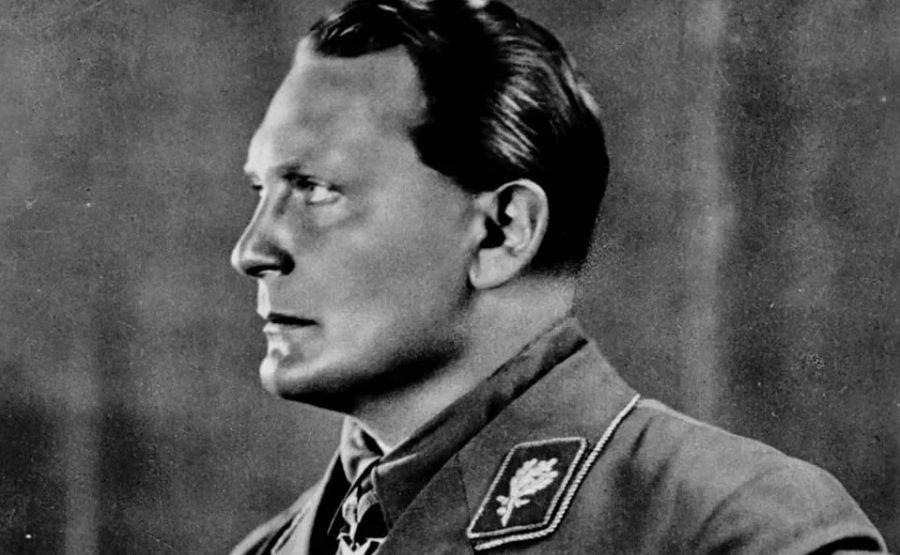
The Addiction and the Long Exile
The morphine dependency that developed from his wound treatment would follow Göring for the rest of his life. By 1925, things were serious enough that Carin had him committed to a Swedish psychiatric asylum. According to reports, he was experiencing extreme psychological suffering and suicide thoughts. He kicked the habit — at least for a while — but it came back. He went through treatment more than once. The addiction shaped his moods, his weight, his judgment, and his relationship with reality for two decades.
During his years of exile in Sweden, the Nazi Party nearly forgot about him. He had little contact with Hitler’s movement through the mid-1920s. But when the party surged back to relevance in the late 1920s, he returned to Germany and got back into politics. By 1928, he had one of the twelve Reichstag seats the Nazis won that year. By 1932, when the party exploded into a national force, Göring was elected president of the Reichstag — speaker of the parliament.
Then, on January 30, 1933, Hitler became chancellor. And everything changed.
At the Summit of Power
Within weeks of Hitler’s appointment, Göring was building the machinery of the Nazi state. He helped create the Gestapo, Germany’s secret political police, and used it to crush political opposition in Prussia. He helped orchestrate the exploitation of the Reichstag fire in February 1933 — the burning of the parliament building, which the Nazis used as a pretext to suspend civil liberties and go after the Communist Party.
Through the 1930s, his portfolio only grew. He was tasked with building the Luftwaffe — Germany’s new air force — from nothing, while officially pretending it didn’t exist until 1935. He recruited pilots, oversaw aircraft development, and poured industrial resources into building what became one of the most powerful air forces in the world. In 1940, Hitler rewarded him with the specially created rank of Reichsmarschall, an honor held by no other German in history. He was officially the most highly ranked military officer in the Reich.
By 1941, he was at the absolute peak of his power and his inflation. He wore increasingly flamboyant uniforms of his own design. He hosted elaborate banquets. He collected art — enormous amounts of it — some purchased, much of it looted from Jewish families and occupied nations across Europe. The estate he built in a forest northeast of Berlin, Carinhall — named for his first wife, who had died of tuberculosis in 1931 — became a palace stuffed with stolen masterpieces.
He married again in 1935, to Emmy Sonnemann, a popular German stage actress. They had one daughter together, Edda, born in 1938. The Nazis turned her birth into a national event.
The Long, Grinding Fall
The rot began in the summer of 1940 over the skies of England. Göring had promised Hitler that the Luftwaffe could destroy the Royal Air Force in a matter of weeks, clearing the way for a German invasion of Britain. It did not happen. The RAF fought back with unexpected ferocity, and the Luftwaffe bled badly — losing something close to two thousand aircraft before the campaign was abandoned. Operation Sea Lion, the invasion plan, was quietly shelved.
Göring’s credibility took a hit it never fully recovered from. And the failures kept coming. At Stalingrad in 1942–43, he guaranteed Hitler that his aircraft could supply the encircled German Sixth Army with the food and ammunition it needed to survive. It was an impossible promise, and he knew it, or should have. The airlift collapsed. The Sixth Army surrendered. And the catastrophe could partly be traced back to reassurances Göring had never been able to keep.
By the final years of the war, the Luftwaffe was being steadily destroyed by Allied air superiority. Göring had largely retreated into Carinhall, increasingly dependent on drugs again, increasingly irrelevant to Hitler’s inner circle. He’d grown enormously fat. He was taking breaks from the war to obsess over his art collection.
When Germany’s military situation became clearly hopeless in April 1945 and Hitler had locked himself in his Berlin bunker, Göring sent a telegram requesting permission to assume leadership of the Reich. Hitler saw it as treason. He had Göring arrested, stripped him of all his titles and positions, and expelled him from the Nazi Party. Even at the very end, their relationship imploded.
Wealth, Finances, and the Art Collection
Göring became extraordinarily wealthy through a combination of state salaries from his multiple positions, personal gifts from businessmen and industrialists who needed his favor, the profits of a massive industrial concern called the Reichswerke Hermann Göring, and — most notoriously — the systematic plunder of art from every country Germany occupied.
From Jewish families forced out of their homes and businesses, from galleries in France and the Netherlands and Poland, from private collections confiscated by the Nazi state’s various looting agencies, the artworks poured into Carinhall. Estimates of the collection’s modern value run to well over a billion dollars. He expressly hired a small group of art specialists to assist him in locating, acquiring, and cataloging the items he was removing. He occasionally offered token payments to create a fig leaf of legitimacy, but it was theft by any honest name.
At the time of his capture in 1945, his wealth in tangible assets was vast. But wealth built entirely on the back of a regime dies with that regime. The art was seized by Allied forces. The estate was blown up by Göring’s own people to prevent it falling intact into Soviet hands. The industrial empire was dismantled. He died with nothing but the clothes on his back and the cyanide capsule somehow hidden on his person.
Nuremberg: The Last Performance
Göring surrendered to American forces in Bavaria in early May 1945. He was taken to Nuremberg, where the International Military Tribunal put him on trial alongside the surviving leadership of the Nazi state.
Something remarkable happened in that courtroom. Göring, who had arrived at Allied custody overweight, drug-dependent, and wearing a custom uniform covered in medals, was cleaned up in captivity. He finally kicked the morphine. He lost weight. And he stood in the dock as the sharpest, most combative, most strategically intelligent defendant of the entire trial. He ran circles around early cross-examination. He refused to show remorse. He insisted he had been a loyal soldier, that he had served his country, that history would eventually be understood.
The tribunal was not persuaded. He was found guilty on all four counts: conspiracy, crimes against peace, war crimes, and crimes against humanity. The sentence was death by hanging.
On the night of October 15, 1946 — hours before the execution was scheduled — Göring bit down on a cyanide capsule in his cell and died. How he obtained it remains disputed to this day. It was the last act of a man who had spent his entire adult life refusing to let anyone else write his ending.
Final Words
Hermann Göring is a figure who resists a comfortable summary. He wasn’t a mindless thug. He was educated, charismatic, and genuinely capable. He was a real war hero at 25. He was also a central architect of the Holocaust’s administrative machinery, a looter of European culture on a staggering scale, and a man who chose every morning for over a decade to serve a murderous regime and prosper from it.
What makes him stand out in the long gallery of history’s villains is the completeness of his trajectory — from decorated pilot who earned genuine respect, to bloated plutocrat playing dress-up in stolen uniforms and stolen art, to defiant prisoners who went out on his own terms with a hidden capsule and no apologies. His story is a study in what ambition without conscience looks like when the machinery of a state gives it everything it wants.
He remains one of the most thoroughly documented and most relentlessly studied figures of the twentieth century, precisely because his contradictions are so sharp and so instructive. Understanding how someone like Göring operates — and how ordinary institutions allow someone like him to rise — is work that doesn’t have an expiration date.
FAQs
1. What was Hermann Göring’s role in the Holocaust?
Göring signed the authorization letter in July 1941 ordering SS General Reinhard Heydrich to prepare a “total solution” to the so-called Jewish question — a document that is considered one of the key administrative starting points of the systematic genocide. He also oversaw the early machinery of persecution, including the legal frameworks that stripped German Jews of their citizenship and property rights.
2. How many planes did Göring shoot down in WWI?
Twenty-two confirmed aerial victories, which qualified him as a flying ace and earned him the Pour le Mérite, Germany’s highest wartime decoration for aviators.
3. Why did Göring get addicted to morphine?
He was shot in the groin during Hitler’s failed Beer Hall Putsch in Munich in November 1923. While recovering, he was given morphine to manage the severe pain, and the dependency took hold from there.
4. Who was Carin Göring?
Carin von Fock was a Swedish noblewoman who left her husband and son to marry Göring in 1923. She had fragile health throughout their marriage and died of tuberculosis in October 1931. Göring grieved her deeply and named his forest estate Carinhall in her memory.
5. What was Carinhall?
Carinhall was Göring’s vast private estate in a forested region northeast of Berlin. It functioned as his palace, hunting lodge, and personal museum — filled primarily with artworks stolen from Jewish families and occupied territories across Europe. German forces blew it up in April 1945 to prevent the Soviets from capturing it.
6. Did Göring actually create the Luftwaffe?
He is credited as its chief architect and first commander. Germany was prohibited from having an air force under the Treaty of Versailles, so the Luftwaffe was initially built in secret under the cover of civilian aviation before being officially revealed in 1935. Göring oversaw its expansion into one of the most formidable air forces of the era.
7. Why did Göring fall out of favor with Hitler?
The failures accumulated. The Luftwaffe’s defeat in the Battle of Britain in 1940 was the first crack. The failed airlift to Stalingrad in 1942–43 deepened Hitler’s distrust. By 1945, Göring’s telegram suggesting he should take over as Hitler’s bunker situation deteriorated was interpreted as a coup attempt, and Hitler had him arrested.
8. How did Göring escape the hangman at Nuremberg?
He bit down on a cyanide capsule hidden somewhere on his person the night before his scheduled execution on October 16, 1946. The exact source of the capsule has never been definitively established — theories range from a sympathetic guard to the capsule having been hidden in his belongings since his capture. He died in his cell early on October 15.
9. What happened to Göring’s art collection?
Allied forces found and seized the collection after the war. Much of it was cataloged and eventually returned to the nations and families it had been stolen from, though that process was enormously complicated and is still ongoing in some cases. Individual pieces from his collection have been the subject of restitution claims for decades.
10. Did Göring show any remorse at Nuremberg?
No, not genuinely. He was combative and intellectually aggressive throughout the trial. He denied personal responsibility for the worst crimes and portrayed himself as a loyal German officer who had served his country. He refused the emotional posture of contrition that some observers hoped to see.
11. What was Göring’s brother Albert like?
Albert Göring is a fascinating historical footnote. Far from being a Nazi supporter, Albert used his famous brother’s name and connections to help Jewish people and opponents of the regime — forging documents, bribing officials, and personally interceding to free prisoners. Several people he helped survived because of him. The two brothers maintained a complicated relationship throughout.
12. How is Göring remembered today?
Primarily as one of the foremost war criminals of the twentieth century and a central figure in the Nazi leadership. He has studied extensively in academic and popular histories of the Third Reich. He is not commemorated or honored anywhere in Germany. The restitution of artworks from his collection continues to be a live legal and ethical issue more than seventy years after his death.
Discover people, ideas, and stories that matter with CelebsBeacon.





One Comment