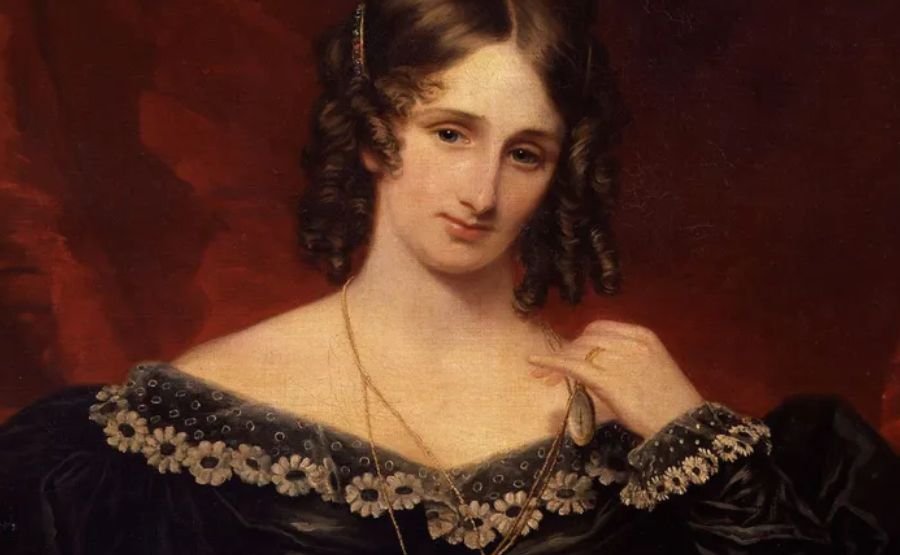
Mary Shelley: The Teenager Who Invented Science Fiction and Changed Literature Forever
Quick Bio
| Detail | Information |
| Full Name | Mary Wollstonecraft Godwin Shelley |
| Date of Birth | August 30, 1797, London, England |
| Date of Death | February 1, 1851, London, England |
| Nationality | British |
| Profession | Novelist, short story writer, essayist, biographer, editor |
| Major Achievement | Author of Frankenstein; or, The Modern Prometheus (1818) — widely considered the first science fiction novel |
| Parents | William Godwin (philosopher); Mary Wollstonecraft (feminist philosopher, died 11 days after Mary’s birth) |
| Husband | Percy Bysshe Shelley (married December 30, 1816; widowed July 1822) |
| Surviving Child | Percy Florence Shelley |
| Other Major Works | The Last Man (1826); edited Percy’s collection of poems; Valperga (1823); Lodore (1835); Rambles in Germany and Italy (1844). |
Who Mary Shelley Is — and Why Her Story Keeps Mattering
Picture a teenager, eighteen years old, sitting in a rented house on the banks of Lake Geneva while a thunderstorm does the kind of thing Alpine thunderstorms do best. She’s in the company of some of the most interesting and difficult people in the English-speaking literary world. And she’s the one who comes up with something that none of the others manage.
What Mary Shelley wrote during those summer evenings in 1816 was Frankenstein — a story that has never, not once, gone out of print since it was first published in 1818. More than that, it invented a whole category of human imagination. For the past 200 years, science fiction has explored the central topic of that book, which is what happens when human desire exceeds the bounds of what should exist.
She wrote it at eighteen. She published it at twenty. She was a widow and raising a child alone by the time she was twenty-five.
Mary Shelley’s life is extraordinary not just for what she created but for what she survived to create it. Loss chased her from the beginning. She grew up without the mother she never met. She buried three of her four children. At twenty-four, she lost her spouse in a drowning accident. She continued to write throughout.
That combination — the scale of the work and the scale of the loss — is what makes her story keep mattering long after the century she lived in has faded from living memory.
See also “John Gotti: The Last Don the World Actually Watched“
Growing Up With the Weight of Two Great Names
Mary Wollstonecraft Godwin arrived in the world on August 30, 1797, in London. The circumstances of that arrival were already shadowed before she took her first breath. Her mother — Mary Wollstonecraft, who had already produced one of the most important feminist texts in the English language in A Vindication of the Rights of Woman — died eleven days after giving birth due to puerperal fever.
That’s the defining fact of Mary’s earliest life. Before she could form a single memory, she had lost the woman whose intellectual legacy she would spend her whole life living inside. William Godwin, her father, was a philosopher of radical politics who had argued against the institutions of government and marriage — and who was completely devastated by the loss of his wife and intellectual partner. He grieved deeply, raised Mary and her older half-sister Fanny (who was not his biological child but Mary Wollstonecraft’s daughter from an earlier relationship), and within a few years took a second wife.
The stepmother, Mary Jane Clairmont, had children of her own and was not, by multiple accounts, warm toward the daughters of her predecessor. Mary grew up feeling the gap — between the mother she could only know through her writings, and the household reality of a stepmother who clearly preferred her own. She pressed her face against her mother’s gravestone in the churchyard of St. Pancras. She became well-versed in Mary Wollstonecraft’s works through reading them.
It’s a specific kind of childhood, this one. Intellectually extraordinary — Godwin’s house in London was visited constantly by William Wordsworth, Samuel Taylor Coleridge, and other writers who made the living room feel like a seminar — and emotionally complicated in ways that would shape everything she eventually wrote.
The Education She Built Herself
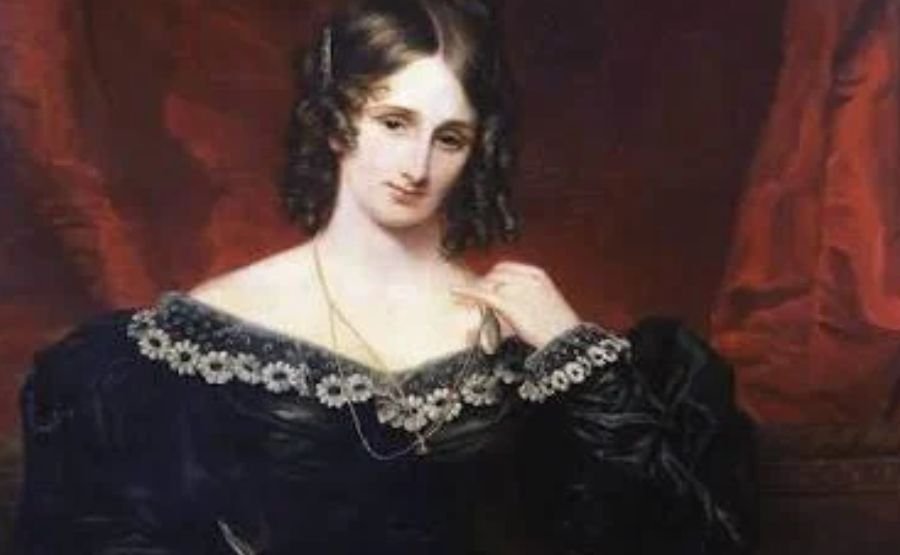
Formally, Mary Shelley’s education was irregular. In the conventional sense, there was no school. What she had was her father, who was a serious intellectual and who taught her with genuine seriousness, and the extraordinary books that filled their home and the extraordinary minds that passed through it.
She learned to read at her mother’s gravestone, reportedly — tracing the letters of Mary Wollstonecraft’s name as a kind of first lesson. She grew up understanding, from the very beginning, that ideas were things people fought for. Her mother had argued for women’s rights at a time when that argument was radical and dangerous. Her father had written political philosophy that challenged the foundations of established society. The air in that household was full of the belief that what you thought and what you wrote actually mattered.
At fifteen, Mary was sent to Dundee in Scotland to stay with friends of her father’s family — a period that gave her space from the complicated London household and access to wild landscape, to the kind of expansive natural world that would find its way into the frozen Arctic openings and closings of Frankenstein. She was already reading voraciously, already writing, already beginning to see the world through the particular imaginative lens that would eventually produce something genuinely new.
The most significant education she received, though, came not from books but from the relationship she was about to begin.
Percy Shelley and the Elopement That Changed Everything
Percy Bysshe Shelley had been visiting William Godwin’s household as a kind of intellectual disciple. He was already a poet with a reputation, and he was already married — to a woman named Harriet, with whom he had two children. He was also brilliant, passionate, volatile, and reckless in ways that would define both the tremendous creative energy and the eventual tragedy of his life.
Mary was sixteen when they fell in love. By the summer of 1814, she and Percy ran away together, taking with them Mary’s stepsister Claire Clairmont, crossing to France and walking or riding through war-damaged European countryside. The elopement was a scandal by the standards of the day and a genuine betrayal of Godwin, who had written against the institution of marriage but very much expected his daughter to actually marry anyone she intended to live with.
The following years were itinerant and financially difficult. Percy’s first wife Harriet was still alive. Money was constantly short. Mary suffered a devastating premature birth — her first child, a daughter, died twelve days after arriving in the world. In March 1815, she had a dream about that loss in her journal that is now interpreted as a precursor to Frankenstein: the dream of resurrecting something that shouldn’t have been gone.
Harriet Shelley drowned herself in a park in London in late 1816. Percy and Mary married within weeks of her death, on December 30, 1816. By then, the summer at Lake Geneva had already happened, and the manuscript that would change everything was mostly written.
The Summer at Geneva: Where Frankenstein Was Born
In May 1816, Mary — who was calling herself Mrs. Shelley though she wasn’t yet married — traveled to Geneva with Percy and their infant son William, along with Claire Clairmont. Claire had by then begun an affair with Lord Byron, the most famous poet in Europe, and the plan was to spend time near his villa beside the lake.
The summer of 1816 was, in fact, not like other summers. The previous year, the eruption of Mount Tambora in the Dutch East Indies had thrown so much ash and debris into the upper atmosphere that weather patterns across the globe were disrupted. Later on, 1816 was dubbed the Year Without a Summer because it was consistently stormy, cold, and dismal, even in June and July. The little group was often confined indoors, and someone proposed they each write a ghost story.
Byron and Percy wrote fragments that went nowhere. Dr. John Polidori, Byron’s personal physician, eventually produced a vampire story. Mary, who was eighteen years old and the youngest person in the room, couldn’t think of anything for days.
And then she had the waking vision. She described it herself later — lying in bed in the dark, not quite asleep, seeing in her mind the pale figure of a student crouched over something assembled from charnel houses and dead men’s parts. Seeing the thing on the floor come to life. Seeing the student flee in horror from what he had made.
She went to her desk the next morning and began writing. The phrase she used to start the manuscript was reportedly: “It was on a dreary night in November.” The story that grew from that vision became Frankenstein; or, The Modern Prometheus — finished in April 1817, published January 1, 1818.
The Novel That Invented a Genre — and Got No Credit for It
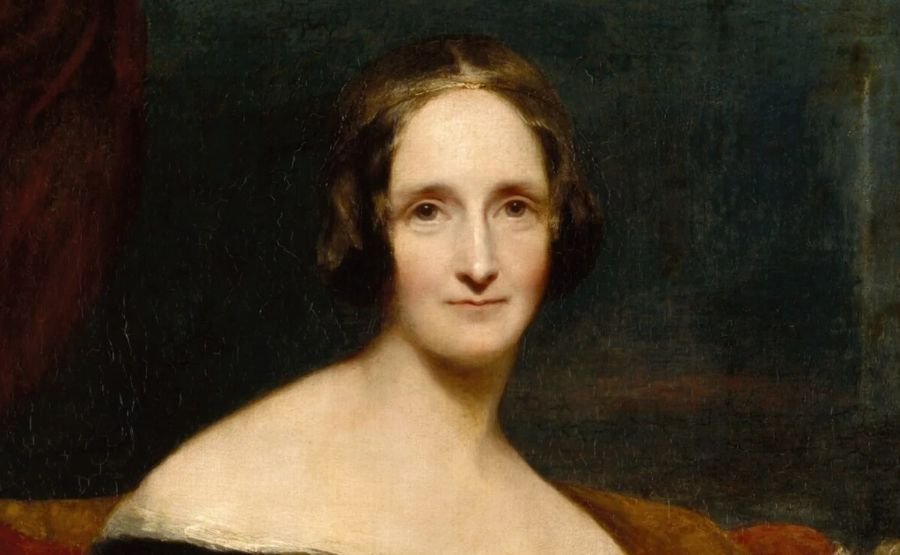
Frankenstein was published anonymously. That wasn’t unusual for the time, especially for a woman — but the preface was written by Percy, and many early readers assumed he had written the whole thing. When the reviews came in, some of them were bewildered, some were positive, and very few figured out immediately that they were reading something categorically new.
What Mary Shelley had done — and this wasn’t fully recognized for generations — was invent the template that all science fiction would eventually follow. Not horror, not Gothic romance (though it contained elements of both), but something with an entirely different engine. Frankenstein isn’t about a monster. It has to do with what happens when creation is done carelessly. It’s about what happens when the impulse to know and to make outstrips wisdom and ethics. Victor Frankenstein isn’t destroyed by the creature — he’s destroyed by his own abandonment of the thing he made.
That’s a philosophical argument, not just a scary story. And it’s been echoing through two centuries of literature, film, science, and ethics because the question it asks has never stopped being urgent.
She went on to write other novels — Valperga in 1823, The Last Man in 1826, The Fortunes of Perkin Warbeck in 1830, Lodore in 1835, among others. The Last Man is particularly striking in retrospect — a plague novel set in the twenty-first century, written in 1826, in which she imagines the end of human civilization through disease. None of these subsequent books achieved the reach of Frankenstein, but they show a writer of serious ambition and range, not someone who produced one lucky book and nothing else.
Grief Piled on Grief: The Italy Years and After
In 1818, the Shelleys relocated to Italy in search of greater space and a warmer environment. Instead, they discovered more loss.
Just over a year old, their daughter Clara passed away in Venice in September 1818 after Percy hurried her across the nation in a carriage to meet his friend Byron. She never fully recovered from the trip. Their son William, who was three, died of malaria in Rome in June 1819. William’s death, the third child Mary had lost in a single year, appears to have caused her to fall into a deep melancholy.
Percy tried to pull her back toward life and work. Prior to her complete comeback, he passed away.
On July 8, 1822, Percy Bysshe Shelley drowned when his sailboat, the Ariel, was caught in a sudden storm near Livorno. He was twenty-nine. Mary was twenty-four and pregnant with a child who did not survive.
She returned to England with Percy Florence — their only surviving son, born in November 1819 — and faced a future that had been entirely stripped of the person around whom her adult life had organized itself.
Writing Through Widowhood: Financial Life and Literary Survival
Percy Bysshe Shelley’s family was aristocratic but hostile toward Mary. His father, Sir Timothy Shelley, regarded her with disapproval and offered minimal financial support, eventually providing a meager allowance on the condition that she not write any biography of Percy. It was a condition designed to keep her controlled and quiet.
She was not quiet. She edited Percy’s collected poetry — publishing the Posthumous Poems in 1824 and the fuller Poetical Works in 1839 — doing the work that established his lasting literary reputation while being prevented from fully taking credit for her role in it. She wrote reviews, essays, and biographical sketches to earn money. She wrote novels.
She was never wealthy. The combination of Sir Timothy’s restrictions, the generally modest earnings available to writers in that period, and the costs of raising a son meant that financial anxiety was a constant companion for much of her widowed life. She managed. She kept writing. When Sir Timothy died in 1844, Percy Florence inherited the baronetcy, and the family’s circumstances improved substantially in the final years of Mary’s life.
She traveled in her later years — her 1844 book Rambles in Germany and Italy records journeys taken with Percy Florence and his friends — and she saw her son settled and financially secure before she died.
The Legacy That Arrived Late but Stayed
Mary Shelley died on February 1, 1851, in London, of what is believed to have been a brain tumor. She was fifty-three years old. She was buried at St. Peter’s Church in Bournemouth, alongside the remains of her parents — William Godwin and Mary Wollstonecraft — which Percy Florence had moved there.
For much of the century after her death, she was remembered primarily as Percy Shelley’s wife and editor. The Frankenstein story was adapted into plays even during her lifetime, and those plays were more widely known than the novel itself. The creature became an icon of popular culture — Boris Karloff’s green-skinned, bolt-necked version in the 1931 Universal film is the image most people still carry in their heads.
But the Mary Shelley who wrote Frankenstein was barely visible in any of that. The first serious scholarly biography wasn’t published until 1989. It took most of the twentieth century for literary scholarship to look seriously at what she had actually written and fully articulate why it mattered.
What we understand now is that she was not a curious footnote to the Romantic literary movement. She was one of its central figures — and arguably the one whose work has aged best.
Frankenstein is still taught in schools. It’s still in university syllabi across the world. Every science fiction novel or film you’ve ever encountered owes something, directly or through inheritance, to the story Mary Shelley wrote in Geneva at eighteen while a storm rolled across the lake. The question she put at the heart of it — can we create something we are not prepared to be responsible for? — has only become more relevant with each passing decade.
Final Words
Here is what stays with you about Mary Shelley when you put her whole story together.
She was born in loss and spent much of her life accumulating more. The mother she never met. The babies she buried. The husband she watched was destroyed by the sea. The long widowhood was shaped by financial constraint and a family that regarded her with suspicion. She had every reason to produce smaller, more cautious work. Or no work at all.
Instead, at eighteen, she wrote a book that asks one of the most important questions the modern world has ever faced. She wrote it not in spite of the darkness she lived in but, somehow, through it. The creature in Frankenstein who is made and abandoned and driven by that abandonment toward terrible things — he’s not just a monster. He’s what grief looks like when nobody takes responsibility for what they’ve created.
Mary Shelley knew a great deal about grief. She turned it into something durable.
FAQs
1. Mary Shelley was born where and when?
She was born on August 30, 1797, in London, England. Mary Wollstonecraft Godwin was her birth name.
2. Who were Mary Shelley’s parents?
Her father was author and radical political philosopher William Godwin. A Vindication of the Rights of Woman author and philosopher Mary Wollstonecraft was her mother. Wollstonecraft died of puerperal fever eleven days after Mary’s birth.
3. At what age did Mary Shelley write Frankenstein?
She conceived the idea in the summer of 1816 when she was eighteen years old, and completed the novel in April 1817 at the age of nineteen. It was published in January 1818 when she was twenty.
4. What inspired Mary Shelley to write Frankenstein?
The idea came from a ghost story competition during a stormy summer at Lake Geneva, Switzerland, in 1816. She, Percy Shelley, Lord Byron, and Dr. John Polidori each agreed to write a horror story. Mary woke up one night with a vivid vision of a student stooping over a terrifyingly assembled creature. She began writing the next morning.
5. Was Frankenstein published under her name?
No. It was published anonymously in 1818, with a preface written by Percy Shelley. Many readers assumed Percy was the author. Mary’s authorship was revealed publicly with the second edition in 1823.
6. Did Mary Shelley and Percy Shelley have children?
They had four children together. Three died young: an unnamed premature daughter who lived twelve days, William who died of malaria at age three, and Clara who died in infancy. Their fourth child, Percy Florence Shelley, survived and outlived his mother.
7. How did Percy Shelley die?
Percy Bysshe Shelley drowned on July 8, 1822, when his sailboat Ariel sank in a storm in the Bay of Spezia near Livorno, Italy. He was twenty-nine years old. Mary was twenty-four.
8. What did Mary Shelley do after Percy died?
She returned to England, raised their son Percy Florence, and continued writing to support herself. She edited and published Percy’s collected poems — doing the critical work of establishing his literary legacy — and wrote novels, essays, and reviews. She lived under financial restrictions imposed by Percy’s father, Sir Timothy Shelley.
9. Did Mary Shelley write other books besides Frankenstein?
Yes, several significant ones. Valperga (1823) was a historical novel set in medieval Italy. The Last Man (1826) imagined a plague wiping out humanity in the twenty-first century — a remarkably prescient book. She also wrote The Fortunes of Perkin Warbeck (1830), Lodore (1835), Falkner (1837), travel writing, and numerous essays and short stories.
10. Why is Mary Shelley credited with inventing science fiction?
Frankenstein was the first significant piece of literature to employ scientific experimentation as the source of its main terror instead of magic or the paranormal. The question it poses: what are the consequences of human scientific ambition without ethical responsibility? — became the defining engine of the science fiction genre that followed over the next two centuries.
11. Was Mary Shelley recognized in her own lifetime?
Partially. Frankenstein was a success, and she was recognized as a writer, though often in Percy’s shadow. She was a respected literary figure in London in her later years, but the full scholarly recognition of her importance — particularly her central role in Romanticism — came much later, primarily in the late twentieth century.
12. When did Mary Shelley die, and what is her legacy?
She died on February 1, 1851, in London, likely from a brain tumor, at age fifty-three. She is interred in Bournemouth with her parents’ reinterred remains. Her legacy is enormous: Frankenstein remains continuously in print after more than 200 years, has been adapted into countless plays, films, and artworks, and is studied globally as a foundational text of science fiction, feminist literature, Romantic literature, and philosophical ethics.
Discover people, ideas, and stories that matter with CelebsBeacon.




One Comment